
The hardest part of crypto payments isn’t moving money. It’s everything around it.
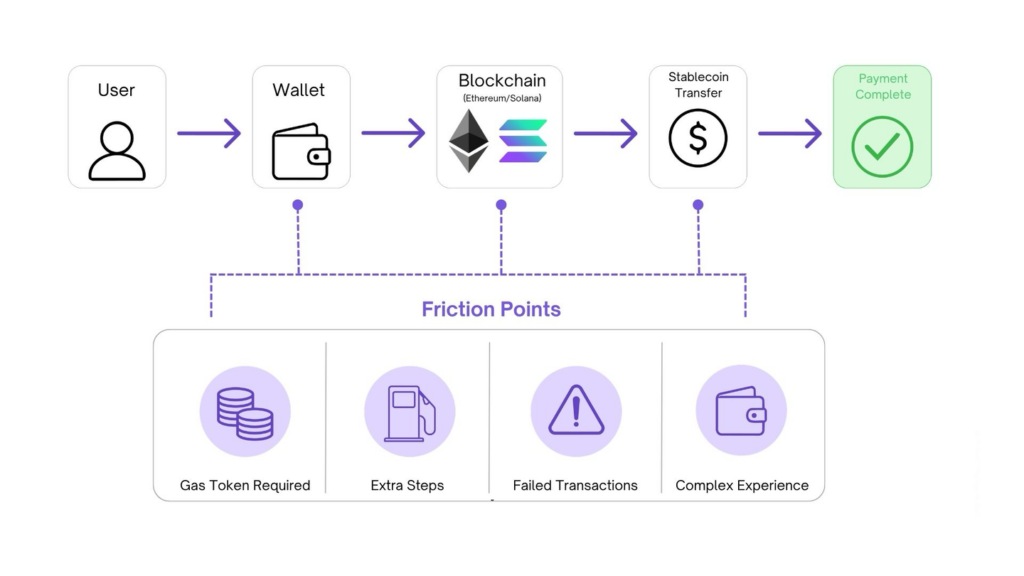
Stablecoins already made global transfers fast and cheap. That problem is largely solved. But every transaction still sits on top of infrastructure that was never designed specifically for payments. That shows up in small but persistent ways: managing gas tokens, dealing with failed transactions, navigating wallets. Individually, these are minor issues. Together, they define the experience. This is the gap most discussions miss. The limitation isn’t speed or cost anymore, its usability. And that’s exactly where the next layer of payment infrastructure is starting to emerge.
The Missing Layer in Crypto Payments
Stablecoins solved the speed and cost problem but failed to solve the usability problem. Every stablecoin transaction depends on the blockchain it runs on, most commonly networks like Ethereum or Solana. These systems are powerful, but they weren’t designed specifically for payments. They’re general-purpose by design, built to support everything from DeFi to NFTs.
Payments are just one use case among many. That design choice shows up in the user experience. What should be a simple action like sending money, comes bundled with concepts that feel unrelated to the task itself. The result is a gap between what crypto enables and what users can actually navigate.
The “Gas Problem”
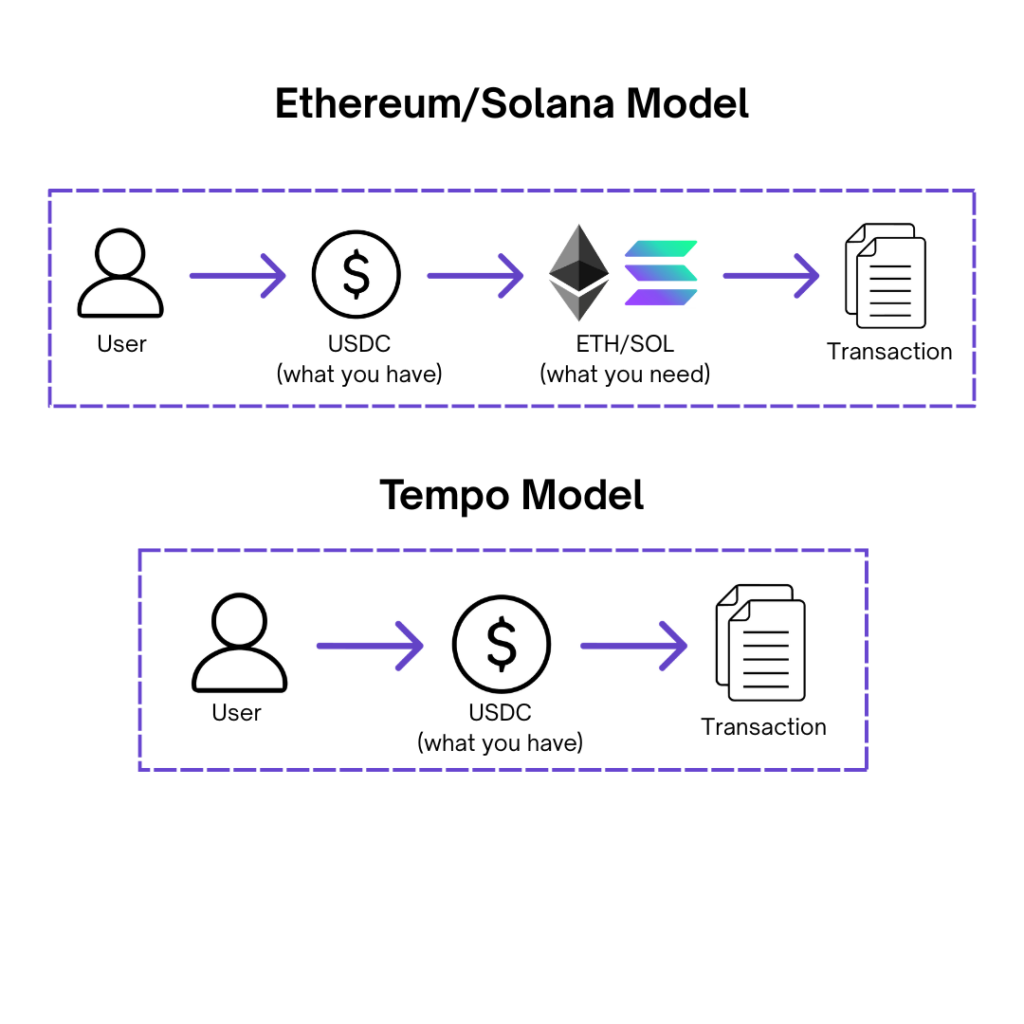
The clearest example is gas fees. On Ethereum, you need ETH to send USDC. On Solana, you need SOL to move stablecoins. The asset you’re transferring and the asset you need to complete the transaction are different.
That mismatch creates friction immediately. A user can hold digital dollars and still be unable to send them. The fix is buying a separate token just to pay fees, which isn’t hard, but it’s unintuitive.
From a system perspective, it makes sense. Networks need a way to price computation and compensate validators. But from a user perspective, it breaks a basic expectation: if you have money, you should be able to send it. That gap is small technically, but significant experientially.
UX Friction as the Real Bottleneck
It’s easy to frame these issues as technical limitations when they’re not. Blockchains today are fast enough. Cheap enough. Scalable enough for most payment use cases. The real constraint is usability.
Managing multiple tokens, tracking gas balances, dealing with failed transactions, these aren’t edge cases. They’re part of the default experience. Even for experienced users, they introduce constant, low-level friction. For new users, they’re often a stopping point.
This is the core problem: crypto payments work, but they don’t feel simple. And until they do, adoption will remain constrained, not by infrastructure, but by experience.
Tempo: A Payment-First Blockchain
Tempo blockchain doesn’t try to be everything at once.
Backed by Stripe and Paradigm, Tempo is built around a narrower assumption: the primary use of blockchains isn’t general computation, it’s moving money. Instead of supporting every possible application, it focuses on doing one thing well: stablecoin payments.
A Different Design Philosophy
Ethereum is a flexible infrastructure. You can build almost anything on it but that flexibility comes with overhead. Every use case inherits the same complexity, whether it needs it or not.
Tempo takes the opposite approach. It starts with the assumption that payments are the core workload, then designs the system around that. Instead of asking developers to adapt a general-purpose chain to payment use cases, it removes the mismatch entirely.
It’s less like a platform and more like a system with a defined job.
Why Specialization Matters
General-purpose systems optimize for possibility. Payment systems need to optimize for reliability and simplicity.
By narrowing its scope, Tempo avoids many of the trade-offs that make existing blockchains harder to use. There’s less abstraction, fewer edge cases, and more predictable behavior. The system doesn’t need to accommodate unrelated workloads, so it can make stronger assumptions about how transactions should work.
The trade-off is obvious: less flexibility. But for payments, flexibility isn’t the bottleneck. Usability is.
Removing Friction: No Native Token
Most blockchains separate the asset you use from the asset you need. You might hold stablecoins, but you still need ETH or SOL to do anything with them. That extra step is so normalized in crypto that it’s rarely questioned but it’s one of the biggest sources of friction in practice. Tempo removes it entirely.
Paying Fees in Stablecoins
On Tempo, there is no native gas token. Transaction fees are paid directly in stablecoins like USDC or USDT, the same assets being transferred. If you have dollars, you can send dollars. That alignment sounds simple, but it changes how the system feels to use.
The gas model in most blockchains introduces a hidden dependency into every transaction. It forces users to think about the network before they think about the payment. Removing that dependency simplifies the entire flow. There’s no need to acquire a second asset, no risk of failed transactions due to missing gas, and no extra step before completing a basic action.
More importantly, it matches real-world expectations. In traditional systems, you don’t need a separate currency to send money, you use what you already have. Tempo brings that same logic on-chain.
We’re seeing this shift firsthand in how we’re building payment systems. The goal is simple: abstract the infrastructure entirely, so users only interact with the asset they already hold. That’s the model we’re working toward with Zeno Bank.
TIP-20: Standardizing Stablecoin Behavior
Now most token standards define interfaces but don’t define behavior. That distinction is subtle, but it’s where a lot of complexity comes from.
On networks like Ethereum, ERC-20 ensures tokens can interact, but it doesn’t guarantee how they behave. Two stablecoins can follow the same standard and still differ in permissions, compliance logic, or transfer rules. Every integration becomes a case-by-case exercise.
TIP-20 takes a more opinionated approach: it standardizes behavior, not just structure.
The Problem with ERC-20
ERC-20 made tokens interoperable but didn’t make them consistent. In practice, stablecoins vary widely:
- Some support blacklisting, others don’t
- Some embed compliance logic, others outsource it
- Some restrict transfers under certain conditions, others remain permissionless
None of this is visible at the interface level. Developers only discover it when things break, or behave differently than expected. So every integration carries hidden complexity. The “standard” becomes a starting point, not a guarantee.
What TIP-20 Introduces
TIP-20 shifts these assumptions into the protocol. Instead of leaving behavior to individual smart contracts, it defines a consistent model for how stablecoins operate. Things like permissions, transfer rules, and compliance mechanisms are built in, not layered on.
The goal is predictability instead of flexibility. Developers don’t need to reverse-engineer token logic or account for edge cases across implementations. They work with a system where the rules are already defined. That removes an entire class of variability from payment flows.
Built-In vs Optional Complexity
On general-purpose chains, complexity is optional but unavoidable. Every project rebuilds the same primitives slightly differently. Instead of composing behavior from scratch, Tempo allows developers to configure it within known constraints. This makes complexity explicit and standardized. It’s a shift from “build everything yourself” to “operate within a defined system.” For payments, that trade-off matters. Less flexibility, but far fewer surprises.
Tempo Transactions: Payments as a First-Class Primitive
On most blockchains, transactions are generic. Payments are just one use case. Tempo reverses that. Transactions are structured around payments from the outset, which changes how flows are executed.
Multiple payments typically require multiple transactions, each adding signatures, fees, and coordination overhead. Tempo bundles them into a single execution. Payroll, disbursements, or split payments can be handled in one step instead of many, reducing operational complexity.
Fee Sponsorship and Parallel Execution
Tempo allows applications to cover transaction fees, so users only need the asset they’re sending. At the same time, non-conflicting transactions can be processed in parallel rather than sequentially, avoiding unnecessary ordering delays in multi-step workflows.
Scheduled Payments
Recurring and time-based payments are built into the protocol. Instead of relying on external automation, transfers can be executed at predefined intervals or timestamps, aligning on-chain behavior with standard financial systems.
Access Permissions (Session Keys)
Rather than full wallet control, Tempo supports scoped permissions. Spending limits, time constraints, and conditional access can be defined without exposing full balances. This is particularly relevant for subscriptions, automated workflows, and AI-driven transactions where controlled execution matters.
Infrastructure for Payments: Speed, Finality, and Reliability
In payment systems, speed only matters if it’s consistent. Tempo targets sub-second block times and fast finality, but the real value isn’t raw performance, it’s predictable confirmation. Transactions don’t just get processed quickly; they reach a point where reversal risk is minimal within a short window. For payments, that reduces ambiguity around settlement.
This shifts how transactions are treated operationally. Instead of waiting for multiple confirmations or handling probabilistic outcomes, applications can assume completion with much higher confidence.
The trade-off is structural. Achieving this level of consistency typically requires tighter validator coordination, which can limit decentralization. Tempo leans into this, prioritizing execution guarantees over network openness.
For payment infrastructure, that’s a deliberate choice: certainty over optional trust models.
The Payment-Only Lane: Prioritizing What Matters
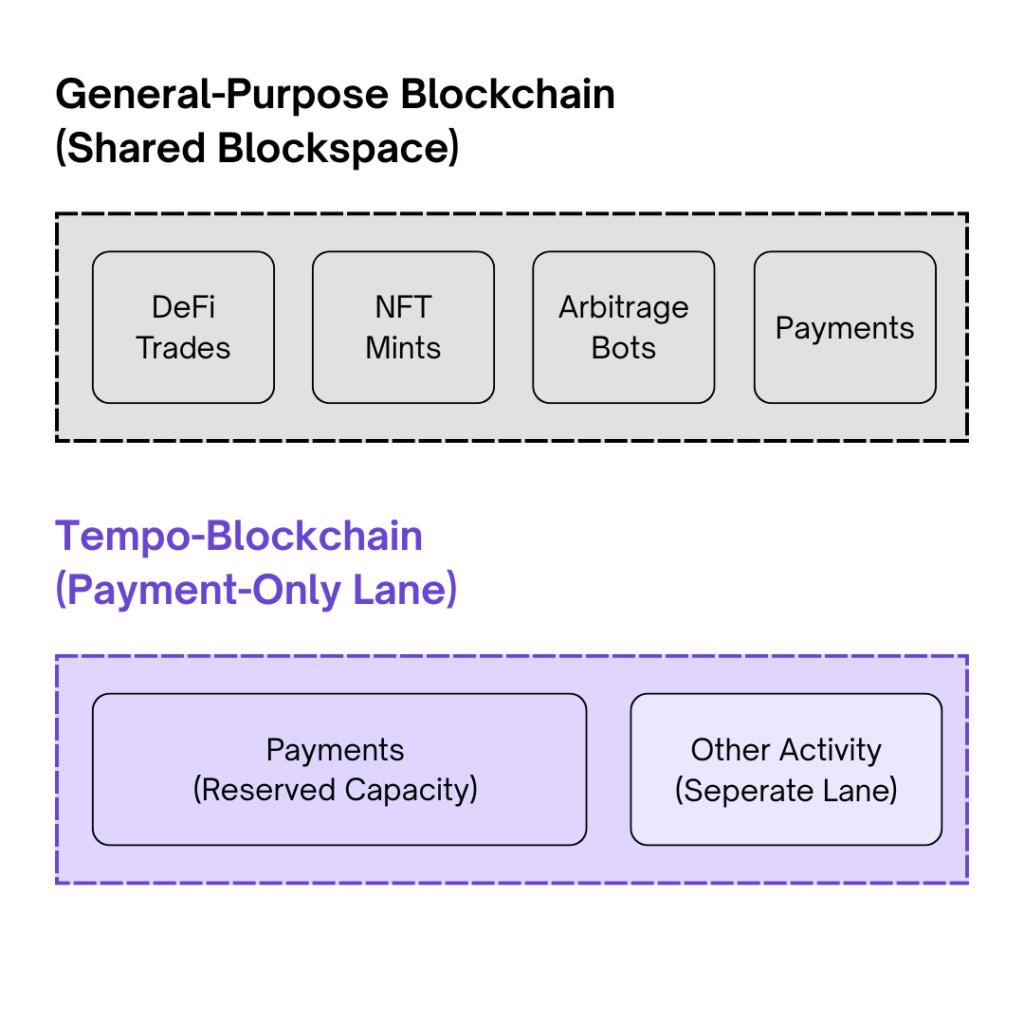
Tempo doesn’t treat all transactions equally like most blockchains do. By reserving execution capacity specifically for payments, it removes them from direct competition with other on-chain activity. This avoids a common failure mode in general-purpose systems, where unrelated demand (trading spikes, NFT activity) affects basic transfers.
The result is not higher throughput, but more stable behavior under load. Fees become more predictable, and inclusion is less dependent on real-time bidding dynamics. For applications, this reduces the need to design around congestion scenarios or sudden cost spikes.
This approach introduces a controlled environment rather than a purely market-driven one. Payments don’t have to compete for space but instead they are guaranteed it. That constraint limits flexibility, but it ensures that the simplest use case, sending money, remains the most reliable one.
Liquidity Design: Making Stablecoins Actually Interoperable
Fast payments only work if liquidity behaves predictably. On most blockchains, it doesn’t.
Stablecoins like USDC and USDT may track the same underlying value, but they exist in fragmented pools. Moving between them often requires routing through multiple markets, each introducing slippage, fees, or execution uncertainty. For payments, this creates invisible friction, the kind that doesn’t break transactions, but makes them inconsistent at scale. Tempo approaches this as a structural problem rather than a market one.
PathUSD: A Routing Layer, Not Another Stablecoin
PathUSD acts as an intermediary layer that connects liquidity across stablecoins. Instead of relying on direct pairwise pools (USDC/USDT, USDT/DAI, etc.), transactions can route through a shared path. The benefit isn’t just fewer steps, it’s predictability. By standardizing how value moves between stable assets, Tempo reduces dependency on fragmented liquidity conditions.
This matters most in high-frequency environments, where even minor inefficiencies compound quickly.
FeeAMM: Ensuring Fees Never Block Execution
A separate but related issue is fee settlement. Even in systems where fees are paid in stablecoins, execution can fail if the exact required asset isn’t available in the right form. Tempo addresses this with FeeAMM; a dedicated mechanism that guarantees conversion into the required fee format at a fixed rate. The goal is simple: transactions should not fail because of liquidity mismatches.
Trade-Off: Hidden Complexity at the Protocol Layer
These abstractions reduce friction for users, but they don’t eliminate complexity, they relocate it.
PathUSD and FeeAMM introduce dependencies on liquidity provisioning and pricing assumptions. Under stress conditions (e.g., depegging or thin liquidity), these systems can become points of risk. Tempo’s approach prioritizes execution reliability over market simplicity. The system works best when liquidity is deep and stable, which is an assumption, not a guarantee.
Who This Is Actually Built For
Tempo’s design only makes sense when viewed through its target users. It is not trying to be a better Ethereum, it’s trying to remove the need to think about blockchains in payment contexts altogether.
On general-purpose chains, building payment systems often means compensating for missing primitives, handling gas abstraction, batching logic, retries, and edge cases manually. Tempo removes much of that overhead. Payments, scheduling, fee handling, and permissions are already part of the system’s baseline behavior. Developers are not assembling infrastructure, they are configuring it. The result is less time spent on workarounds, and more on actual application logic.
Businesses: Predictability Over Optionality
For businesses, the priority is consistency before flexibility.
Variable fees, delayed settlement, and unreliable execution are manageable in low volumes, but become costly at scale. Tempo’s design choices: fixed fee behavior, reserved blockspace, fast finality, all converge on one outcome: predictable payment flows.
This is particularly relevant for:
- Cross-border remittance platforms
- Payment processors
- Fintech applications handling high transaction volume
The system is optimized for environments where reliability matters more than composability.
Automated Systems: Payments Without Human Intervention
One of the more forward-looking aspects of Tempo is its alignment with automated execution. With support for scheduled payments and scoped permissions (session keys), transactions can be initiated and managed by software rather than users. This enables:
- Subscription systems without manual triggers
- Machine-to-machine payments
- AI-driven financial operations
In these cases, the requirement is deterministic behavior under constraints.
At Zeno Bank, our goal is to make crypto payments behave like standard financial infrastructure. Design choices like these reduce the amount of system-level work needed to deliver a consistent user experience.
Trade-Offs: What Tempo Gives Up to Work This Well
Tempo’s design is coherent, but it is not neutral. Every simplification comes from removing something. The most immediate trade-off is scope. By optimizing for payments, Tempo limits what can be built natively on top of it. This is not a platform for experimentation across arbitrary use cases. It is infrastructure with a defined boundary.
That constraint shows up in three ways. First, reduced flexibility. Developers cannot assume the same level of composability available on general-purpose chains. If an application falls outside payment-centric logic, it will either require external systems or won’t fit cleanly at all.
Second, validator structure and decentralization. Systems that prioritize fast finality and consistent execution typically rely on tighter coordination. This can lead to smaller validator sets and a more controlled environment, improving performance, but concentrating trust.
Third, dependency on stablecoin integrity. Tempo’s entire model assumes that stablecoins behave as expected. If underlying assets lose their peg or face regulatory disruption, the system inherits that instability directly.
None of these are flaws in isolation. They are consequences of choosing predictability over generality. The real question is not whether these trade-offs exist, it’s whether they align with the needs of payment systems. Tempo assumes they do.
Where This Fits: Not a Replacement, but a Different Category
Tempo is easiest to misunderstand when compared directly to existing blockchains. It is not trying to outperform them across the same dimensions. It is redefining the category it operates in.
General-purpose chains like Ethereum and Solana function as execution environments, they maximize what can be built. Tempo functions more like financial infrastructure, it optimizes how a specific activity behaves. That distinction matters.
In practice, this means Tempo is unlikely to replace existing ecosystems. Instead, it fits alongside them, handling a narrower but more operationally critical layer: moving money reliably.
If that layer works well, most users won’t need to know it exists.
This is the deeper shift Tempo represents. Not a new feature set, but a change in how blockchain systems are evaluated:
- Less focus on programmability
- More focus on execution guarantees
- Less emphasis on optionality
- More emphasis on consistency
Whether this approach succeeds depends on adoption, not architecture. Payment systems are judged in production, under real usage, not in design. Tempo’s bet is simple: if crypto payments are going to scale, they need infrastructure that feels invisible. And that requires building less, but building it with far more intention.
Conclusion
Most blockchain systems start with a broad premise, build flexible infrastructure, and use cases will follow. Tempo inverts that logic. It starts with a constraint: payments are the only thing that needs to work, and everything else is secondary.
That shift changes how the system is evaluated. The question is no longer how much can be built on top of it, but how reliably it performs a single function under real conditions. If it succeeds, Tempo won’t stand out as a “better blockchain.” It will fade into the background as infrastructure, something applications rely on without exposing users to its mechanics.
If it fails, it won’t be because the design is unclear. It will be because real-world payment flows demand edge cases, scale conditions, and regulatory realities that no clean architecture can fully anticipate.
Either way, the direction is clear. The next phase of crypto payments won’t be defined by adding more features, but by removing the need to think about them at all.
See how we’re applying this model in real-world payments at zenobank.io